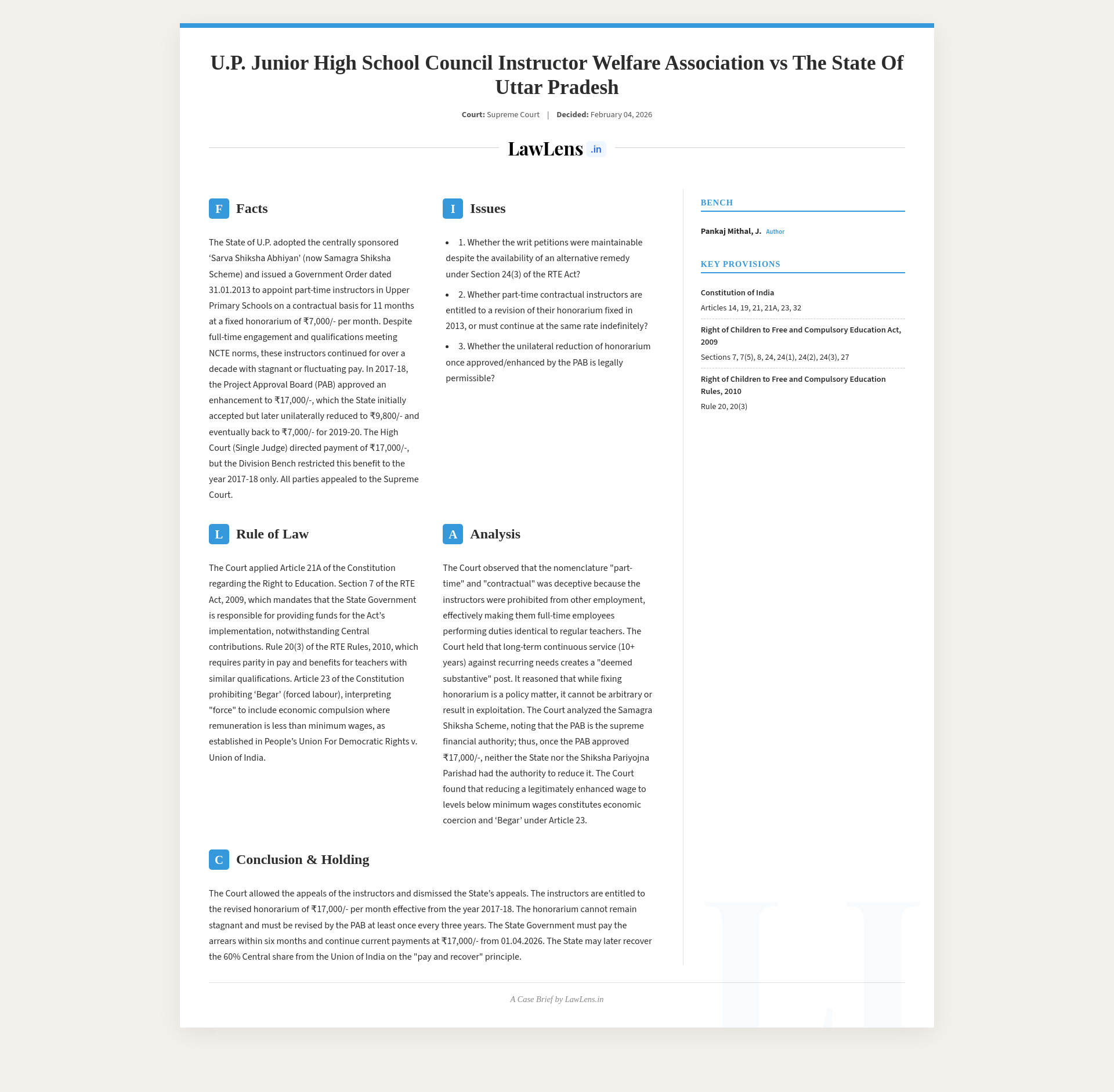
U.P. Junior High School Council Instructor Welfare Association v. State of Uttar Pradesh - Art.23 Constitution - Begar - Contractual Teachers

Constitution of India - Article 23 - “Forced labour” to encompass any work or service rendered unwillingly as a result of force or compulsion- This Article takes a hit at every form of forced labour, whether it is a direct case of forced labour or case of forced labour hidden under the guise of voluntary work or contractual work. (Para 54) [Context: In this case, SC held that any action of the State/Union Government to employ instructors/teachers on a fixed honorarium of Rs.7,000/- per month as was initially fixed in 2013-14 amounts to ‘Begar’ and unfair practice which is violative of Article 23 of the Constitution ]
Constitution of India - Article 226- The existence of an alternative remedy under a statutory scheme does not operate as an absolute bar to the exercise of writ jurisdiction under Article 226 of the Constitution. This is particularly so in cases where the writ petition has already been entertained by the Court, pleadings have been completed, and the matter has been adjudicated on merits. In such circumstances, relegating the parties to an alternative forum would defeat the ends of justice and render the prior proceedings redundant - where the facts so justify, the Court retains full discretion to entertain and decide a writ petition notwithstanding the availability of an alternative remedy. (Para 29-30)
Teachers - Teachers command the highest respect in society and are revered/worshipful as Gods - We must accord the highest regard and respect to our teachers at all levels, even at the level of the government, especially the primary teachers. They have to be compensated for their work most suitably. In fact, no honorarium would be enough to compensate the services rendered by our teachers. (Para 38)[Context: SC held that part time contractual instructors/teachers appointed in the Upper Primary School in the State of U.P. are entitled to revision of their honorarium of Rs.7,000/- per month which was initially fixed for the contract period of eleven months in the year 2013 and that the said revision has to take place, if not annually then periodically as per the discretion of the PAB. Since the PAB for the year 2017-18 had determined the said honorarium to be Rs.17,000/- per month, all instructors/teachers appointed under the scheme are entitled for the payment of the same at the above rate of Rs.17,000/- per month with effect from 2017-18 till further revision takes place.]
Case Info
Case name and neutral citation
U.P. Junior High School Council Instructor Welfare Association v. State of Uttar Pradesh & Ors., Civil Appeal No. ___ of 2026 (arising out of SLP (C) No. 9459 of 2023), with connected Civil Appeals (arising out of SLP (C) Nos. 1744–1749 of 2026 and 3331–3334 of 2024).Neutral citation is not printed in the text provided (only “REPORTABLE” and cause-title are given).
Coram
Bench: Hon’ble Mr. Justice Pankaj Mithal and Hon’ble Mr. Justice Prasanna B. Varale.
Judgment date
4 February 2026, New Delhi.
Caselaws and citations referred
- Rajasthan State Electricity Board v. Union of India, (2008) 5 SCC 632.
- Harbanslal Sahnia v. Indian Oil Corporation Ltd., (2003) 2 SCC 107.
- Jaggo v. Union of India and Ors., 2024 SCC OnLine SC 3826.
- People’s Union for Democratic Rights v. Union of India, (1982) 3 SCC 235.
Statutes / laws and legal instruments referred
- Constitution of India
- Article 21A (Right to Education).
- Article 23 (Prohibition of traffic in human beings, begar and forced labour).
- Article 226 (writ jurisdiction – discussed through case-law).
- Constitution (Eighty-Sixth Amendment) Act, 2002 (insertion of Article 21A).
- Right of Children to Free and Compulsory Education Act, 2009
- Section 7(3), 7(4), 7(5) (financial responsibilities and sharing between Centre and State).
- Section 8 (State’s duties for quality elementary education).
- Section 24(1)–(3) (duties of teachers and redressal of grievances).
- Section 27 (restriction on deployment of teachers for non‑educational work).
- Right of Children to Free and Compulsory Education Rules, 2010
- Rule 20(3) (pay, allowances and benefits of teachers to be at par with similarly placed teachers).
- Minimum Wages Act, 1948 (referred in substance as “the minimum wages Act” and its notified minimum wage for unskilled workers).
- Centrally sponsored schemes
- Sarva Shiksha Abhiyan (SSA).
- Samagra Shiksha Scheme (which subsumed SSA) including its fund‑sharing pattern and institutional structure (Project Approval Board (PAB), State Executive Committee, etc.).
Three‑sentence brief summary
The Supreme Court held that so‑called “part‑time contractual” instructors in Upper Primary Schools of Uttar Pradesh, appointed under Sarva Shiksha Abhiyan/Samagra Shiksha, in fact function as full‑time teachers against deemed permanent posts and cannot be kept on a stagnant honorarium of ₹7,000 per month or have their remuneration reduced after enhancement. Recognising the Project Approval Board (PAB) as the sole financial authority under the scheme, the Court ruled that once PAB approved honorarium of ₹17,000 per month for 2017–2018, neither the State nor any other body could lawfully pay less, and that any such persistent low payment amounts to economic coercion and “begar” prohibited by Article 23. It therefore directed the State to pay all such instructors ₹17,000 per month with effect from 2017–18 (prospectively from 1 April 2026 with arrears for the intervening period), and held that honorarium must thereafter be periodically revised by PAB at least once in three years, with the State bearing primary liability on a “pay and recover” basis vis‑à‑vis the Union.