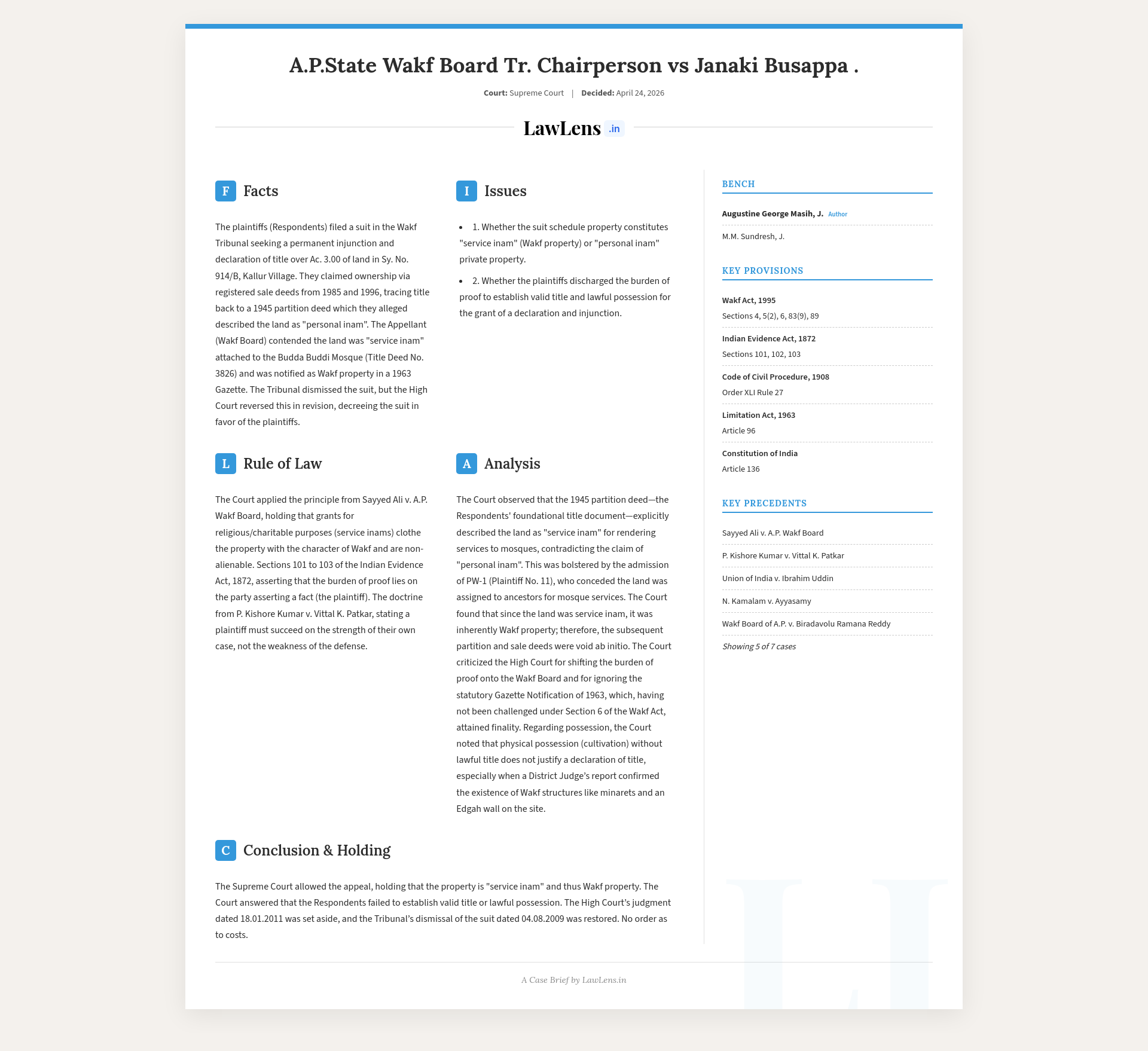
A.P. State Wakf Board through Chairperson v. Janaki Busappa 2026 INSC 413 - Wakf - Suit For Declaration
In a suit for declaration of title, the burden lies squarely upon the plaintiff to establish a clear and legally sustainable title, and such a claim cannot succeed merely on perceived weaknesses in the defendant’s case

Wakf - A grant of land for rendering religious or charitable services does not vest absolute title in the individual, and such grants, being for purposes recognised under Muslim law as pious, religious or charitable, would clothe the property with the character of Wakf. (Para 25) [Context: The Supreme Court held that the suit land in Sy. No. 914/B at Kallur is “service inam” attached to Budda Buddi Mosque and Asthabal Masjid, and therefore partakes the character of Wakf property, making the partition deed of 01.06.1945 and subsequent sale deeds in favour of the plaintiffs void and incapable of conferring title. ]
Civil Suit - Declaration Of Title -In a suit for declaration of title, the burden lies squarely upon the plaintiff to establish a clear and legally sustainable title, and such a claim cannot succeed merely on perceived weaknesses in the defendant’s case. The failure to produce cogent title documents is fatal to the claim. (Para 33) Mere physical possession, in the absence of lawful title, would not entitle a party to the relief of declaration or injunction. (Para 35)
Pleadings– Clear and unequivocal admissions made by the parties in pleadings constitute substantive evidence, the said decision also recognises that evidentiary admissions may not be conclusive but can be evaluated in the context of the overall material on record. (Para 27)
Indian Evidence Act, 1872 - Section 101- The burden of proving a fact always lies upon the party who asserts it, and until such burden is discharged, the opposing party is under no obligation to establish its case- A court cannot proceed on the weakness of the defence unless the party on whom the burden lies has first discharged the same. (Para 34)
Case Info
Basic Case Details
Case name: A.P. State Wakf Board through Chairperson v. Janaki Busappa and Others
Neutral citation: 2026 INSC 413
Coram:Justice M.M. SundreshJustice Augustine George Masih
Judgment date: April 24, 2026Court/jurisdiction: Supreme Court of India, Civil Appellate Jurisdiction, Civil Appeal No. 1946 of 2013
Caselaws and Citations Referred
- Sayyed Ali v. A.P. Wakf Board, (1998) 2 SCC 642
- P. Kishore Kumar v. Vittal K. Patkar, (2024) 13 SCC 553
- Union of India v. Ibrahim Uddin, (2012) 8 SCC 148
- N. Kamalam v. Ayyasamy, (2001) 7 SCC 503
- Wakf Board of A.P. v. Biradavolu Ramana Reddy, (1999) 6 SCC 582
- Nagindas Ramdas v. Dalpatram Ichharam, (1974) 1 SCC 242
- Rangammal v. Kuppuswami, (2011) 12 SCC 220
Statutes / Laws Referred
- Wakf Act, 1995
- Section 4 (Survey of wakfs)
- Section 5(2) (Publication of list of wakfs – Gazette notification)
- Section 6 (Disputes regarding wakfs – limitation and finality)
- Section 83(9) (Revision to High Court from Wakf Tribunal)
- Section 89 (Mandatory notice – raised as issue of maintainability)
- Code of Civil Procedure, 1908
- Order XLI Rule 27 (Additional evidence in appeal)
- Indian Evidence Act, 1872
- Sections 101–103 (Burden of proof)
- Section 101 specifically discussed with case law
- Limitation Act (Article 96 discussed contextually via Wakf Board A.P. case, though limitation ultimately held inapplicable to this controversy)
Three‑Sentence Brief Summary
The Supreme Court held that the suit land in Sy. No. 914/B at Kallur is “service inam” attached to Budda Buddi Mosque and Asthabal Masjid, and therefore partakes the character of Wakf property, making the partition deed of 01.06.1945 and subsequent sale deeds in favour of the plaintiffs void and incapable of conferring title. Emphasising that a plaintiff must succeed on the strength of their own title and that service inam grants for religious purposes are inherently Wakf, the Court found that the plaintiffs neither proved valid title nor lawful possession, and that the High Court had wrongly shifted the burden of proof onto the Wakf Board while re‑appreciating evidence in revision. Consequently, the Supreme Court set aside the Andhra Pradesh High Court’s order dated 18.01.2011 and restored the Wakf Tribunal’s judgment and decree dated 04.08.2009 dismissing the suit.